
AI & Innovation
When the AI Is Wrong: Leading in the Age of Confident Errors, AI tools are confidently wrong more often than most leaders realize. The executives who thrive in the AI era aren't the ones who trust AI the most; they're the ones who know exactly when not to.

Daniel Dopler
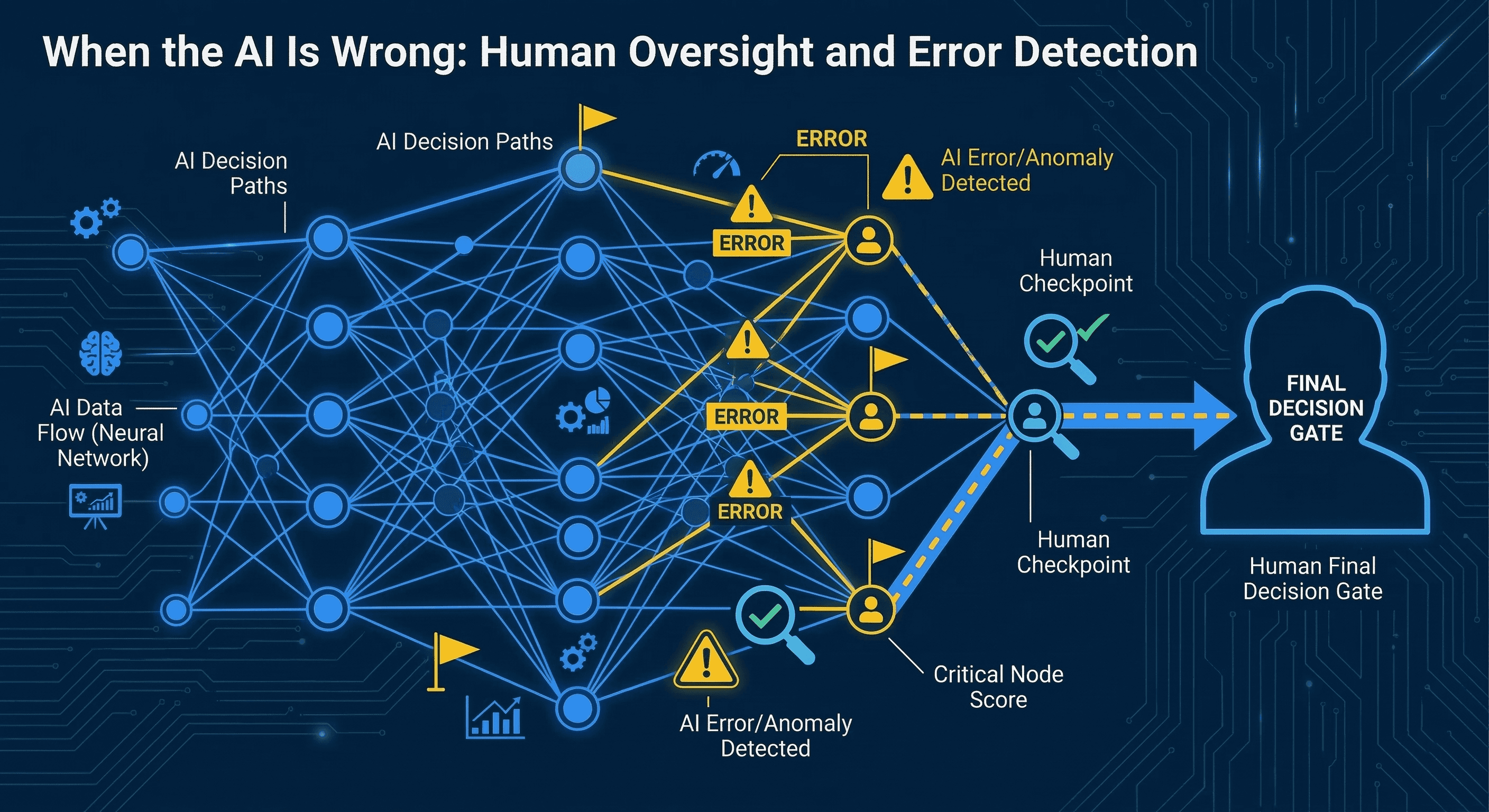
When the AI Is Wrong: Leading in the Age of Confident Errors
There's a failure mode in AI that no one talks about enough at the executive level: confidence without accuracy.
A junior EOD technician who's unsure will tell you they're unsure. An AI model that's hallucinating will give you a five-paragraph response in perfect prose with zero indication that it invented two of the three sources it cited.
That gap, between confidence and accuracy, is the most dangerous place in modern organizational decision-making.
What AI Confidence Actually Means
When a language model generates a response, it isn't reasoning through evidence the way a human expert does. It's predicting the most statistically likely next token given its training data. That process produces fluent, confident-sounding output regardless of whether the underlying information is correct.
This is not a flaw that will be fully solved in the next model release. It is a structural property of how these systems work. The leaders who understand this use AI as an accelerant. The leaders who don't use it as a liability.
The Three Failure Patterns I See Most
The first is what I call Unverified Delegation, handing a high-stakes task entirely to an AI tool and treating the output as final. This happens most often with writing tasks such as market analysis, executive summaries, and technical briefs. The output looks polished. The data inside it may be fabricated.
The second is Competitive Pressure Override, using AI-generated content under deadline pressure without verification, because the alternative is missing the deadline. This is how organizations create serious reputational risk at scale.
The third is Expertise Decay, the slow erosion of human judgment in domains where AI handles most of the work. When your team stops being able to evaluate AI outputs critically, you've outsourced your quality control to the model itself. That's a loop with no error correction.
The EOD Mental Model for AI Risk
In EOD, we operate in environments where the cost of confident wrong answers is catastrophic and irreversible. We developed a culture of deliberate verification, not because we distrusted each other, but because we understood that the consequences of unverified confidence were permanent.
I apply the same mental model to AI workflows.
Before any AI-assisted output is used for a decision, I ask three questions: What would have to be true for this to be wrong? Can I verify the two most important facts independently? If this output is incorrect, how bad is the outcome?
That third question is the one most people skip. It's the most important one.
How to Lead AI-Augmented Teams
The leaders who will win in the next five years are not the ones who adopt AI the fastest. They're the ones who build organizations that use AI confidently and verify intelligently.
That means building a human-in-the-loop review for any AI output that drives a material decision. It means creating cultures where "I checked the AI's work and found an error" is praised, not seen as inefficiency. And it means developing your own ability to evaluate AI outputs in your domain, not just to use them.
AI is the most powerful accelerant available to modern leaders. Accelerants without containment are just fires.