
Leadership & Strategy
Tactical, operational, and strategic leadership aren't just military concepts; they're the exact three levels every high-performing business organization needs. EOD veteran Danny Dopler breaks down how to lead at all three.

Daniel Dopler
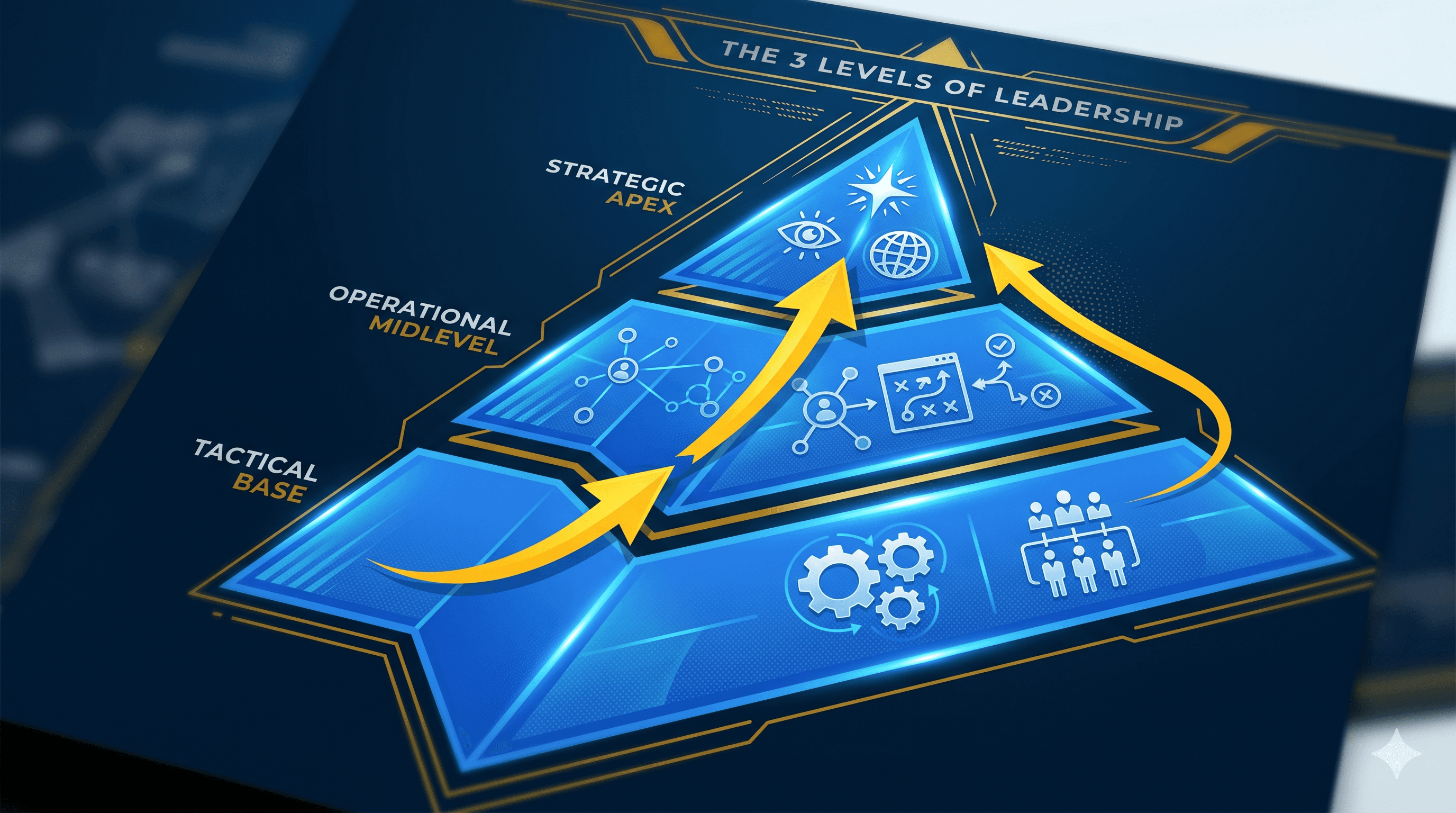
The 3 Levels of Leadership I Learned in EOD (And How They Map to Business)
There's a failure mode I see constantly in high-performing organizations: leaders who are excellent at one level of leadership and completely ineffective at the others.
The senior engineer who can't stop diving into code when she's been promoted to manager. The director who is brilliant at strategy but can't explain it to his team in a way they can act on. The manager who executes flawlessly but can't connect her team's work to anything larger.
In the military, this isn't a personality problem. It's a training failure. Because the military explicitly teaches three levels of leadership, tactical, operational, and strategic, and expects leaders to know which one applies at any given moment.
Level 1: Tactical Leadership
Tactical leadership is about execution at the small-unit level. This is the petty officer leading a squad, the EOD team leader clearing a device, the shift supervisor managing today's workload.
What it looks like: Direct supervision, technical mastery, immediate problem-solving. The tactical leader is at work. She sees the details, manages the tempo, and adapts in real time to what's happening right in front of her.
What it requires: Presence, decisiveness, and deep competence in the craft. Tactical leaders can't afford to be vague. Their job is to turn intent into action.
Corporate equivalent: Individual contributors, team leads, and first-line managers. The people who close the sprint, ship the product, and run the client call.
The failure mode: Staying tactical when you've been promoted. This is the leader who can't stop doing the work himself because trusting others to do it feels too slow or too risky.
Level 2: Operational Leadership
Operational leadership coordinates multiple tactical elements toward a shared outcome over a sustained time period. This is the company commander, the Mobile Unit operations officer, and the senior NCO who keeps three platoons moving toward the same objective.
What it looks like: Resource allocation, sequencing, dependency management, and cross-team coordination. The operational leader doesn't do the work; she ensures the conditions for the work are right.
What it requires: Systems thinking, stakeholder management, and the ability to translate strategic guidance into executable plans for tactical teams.
Corporate equivalent: Directors, senior managers, and program leads. The people who own the roadmap, manage cross-functional dependencies, and translate leadership priorities into team-level work.
The failure mode: Treating operational problems like tactical ones (micromanaging execution) or strategic ones (thinking big thoughts without connecting them to the people doing the work).
Level 3: Strategic Leadership
Strategic leadership sets direction, shapes culture, and makes the decisions that define what an organization is and what it's trying to become.
What it looks like: Long-horizon thinking, organizational design, resource investment, and external positioning. The strategic leader operates at the level of the institution, not the mission.
What it requires: Pattern recognition across domains, the discipline to resist short-term urgency, and the ability to communicate a compelling vision of the future that tactical and operational leaders can orient toward.
Corporate equivalent: VPs, C-suite, and senior executives. The people who define the strategy, allocate the budget, and make the bets that determine where the organization is in five years.
The failure mode: Disconnection. Strategic leaders who can't explain their thinking in terms that operational and tactical leaders can act on create drift, frustration, and wasted effort.
The Real Insight: You're Always in All Three
Here's what the military understands that most corporations don't: you're never just one level.
An EOD Senior Chief operates tactically on a given mission, operationally across his platoon's training calendar and deployment cycle, and strategically when he's shaping how his unit approaches new threat environments.
The same is true for leaders at every level. A good director executes tactically when she's in a client meeting, operationally when she's managing her team's quarterly commitments, and strategically when she's advising the VP on organizational priorities.
The failure isn't being at one level. The failure is being stuck there.
How to Use This
When you're in a meeting or making a decision, ask yourself: which level does this problem live at?
If it's a tactical problem, get in the work. Don't manage from a distance. Be present, be specific, and be decisive.
If it's an operational problem, focus on conditions, not tasks. Your job is to remove obstacles, sequence work, and ensure your tactical teams have what they need.
If it's a strategic problem, stop acting. Your job is to think clearly, communicate the intent, and make the decision that everyone else is waiting for.
The Takeaway
Most leadership failures aren't capability failures. They're level failures. Leaders are operating at the wrong altitude for the problem in front of them.
The highest-leverage skill a leader can develop is the ability to shift fluidly between tactical, operational, and strategic thinking, and to know exactly which one the moment calls for.