
AI & Innovation
5 Things the MBA Got Right About Leadership (And 2 It Got Wrong): I walked into Michigan Ross with 18 years of military leadership experience. Here's what the program confirmed, what it challenged, and the two things it still hasn't fully figured out.

Daniel Dopler
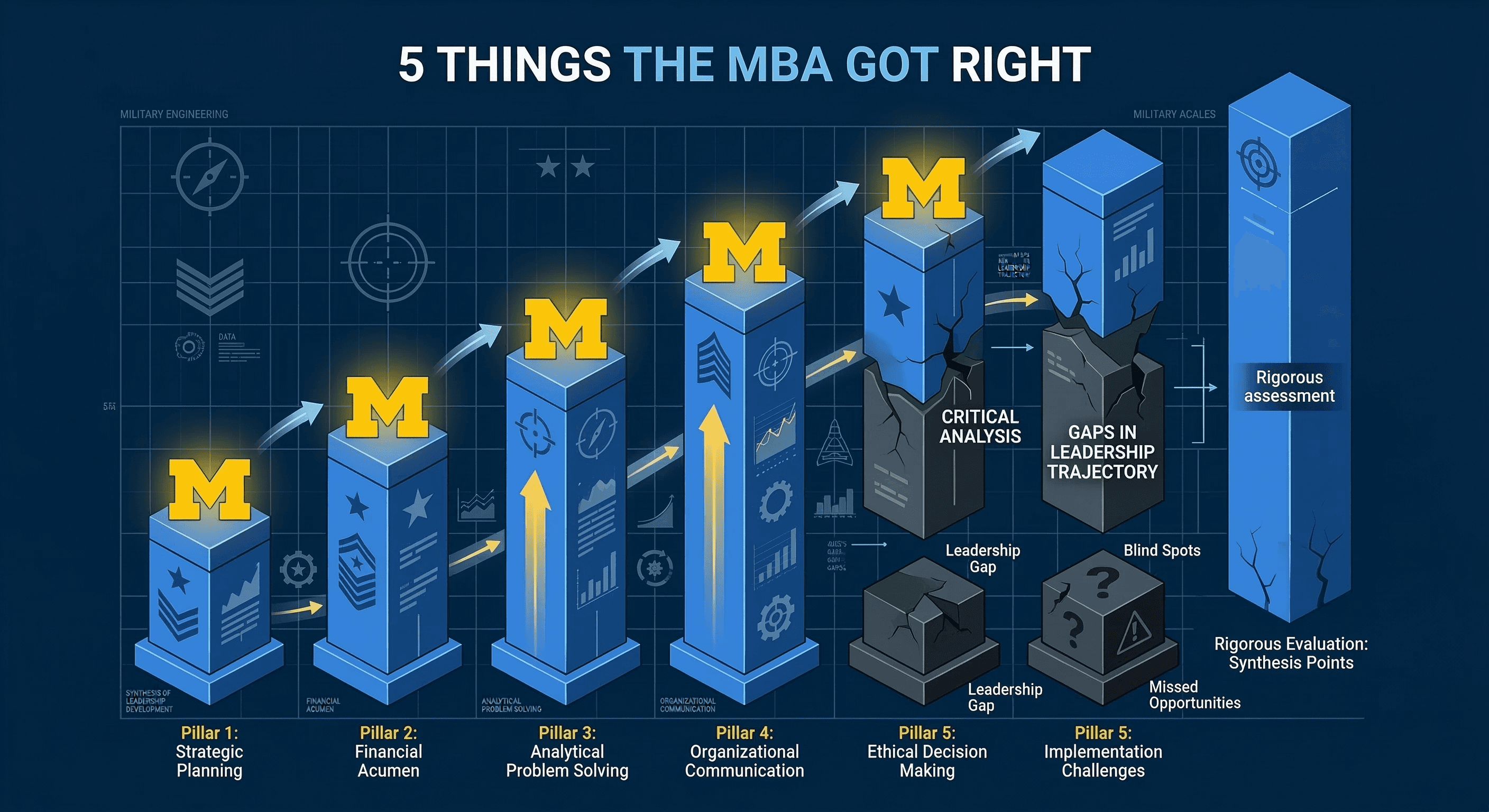
5 Things the MBA Got Right About Leadership (And 2 It Got Wrong)
I arrived at Michigan Ross with nineteen years of military leadership experience and a healthy skepticism about what a business school could teach me about leading people.
That skepticism was partially justified. And partially very wrong.
Here's what I found.
What the MBA Got Right
Strategy is a skill, not a talent. The military develops operational excellence systematically. It is less deliberate about strategic thinking, the ability to look three to five years out, model competitive dynamics, and make resource allocation decisions in the absence of clear signals. Ross taught me that strategic thinking is a learnable discipline with specific tools, frameworks, and practices. I was a better strategic thinker as I leave the program than when I entered. That surprised me.
Financial literacy is a leadership capability. I had zero formal finance background when I started. I understood budgets. I didn't understand how money moved through a business, how capital structure affected strategic optionality, or how to read a balance sheet as a leadership document. The finance curriculum was the most practically valuable thing I did in the program, not because I became a CFO, but because I became a leader who could speak the language of resource allocation at the executive level.
Diverse teams solve harder problems. The military develops deep competency in building cohesive teams. It is less systematic about building cognitively diverse teams. At Ross, I worked alongside classmates from twenty-two countries across fifteen industries. The problems we solved together were better for the perspective heterogeneity. I carry that lesson into every team I build.
Data fluency separates good leaders from great ones. The ExecMAP project at Airbnb projected a 1,300% ROI on a $1M investment through data-driven program design. I could not have led that project without the analytical toolkit I built in the MBA. Gut instinct matters. Data-informed gut instinct is better.
Communication is strategy. Ross was the first environment where I received structured, systematic feedback on how I communicate, not just whether I communicated effectively, but how my communication choices shaped the decisions and perceptions of my audience. That feedback was valuable and uncomfortable in equal measure.
What the MBA Got Wrong
Experience hierarchy matters more than programs acknowledge. The MBA cohort model creates artificial intellectual egalitarianism. A twenty-four-year-old two years out of undergrad and a thirty-seven-year-old with eighteen years of operational leadership are not peers in a leadership discussion, regardless of how the classroom structures the conversation. The best professors navigated this. Some didn't. The result, in the latter cases, was that significant practical leadership wisdom in the room went underutilized.
The real curriculum is still mostly Western, corporate, and short-term. The strategic frameworks I learned were overwhelmingly derived from U.S. corporate contexts with planning horizons of one to five years. The military operates on ten-to-twenty-year strategic cycles, in coalition environments, under political constraints that dwarf anything in the corporate world. That context produced a different kind of strategic thinking, one that the MBA didn't have a good vocabulary for. I'm still working on the translation.
The Verdict
I would go back and do it again. Immediately.
Not because the MBA completed my leadership education. Because it gave me tools, language, and a network that materially changed what I can build, and with whom. The ROI, measured honestly, has been significant.
But the best version of the degree is the one you bring your experience into, not the one you receive passively. Walk in with your skepticism intact. Let it be challenged. Keep what survives.