
Leadership & Strategy
From nuclear physics to AI strategy, Navy EOD Senior Chief Danny Dopler reveals the CODE system, Collect, Organize, Distill, Express, that turns information overload into operational mastery faster than you think.

Daniel Dopler
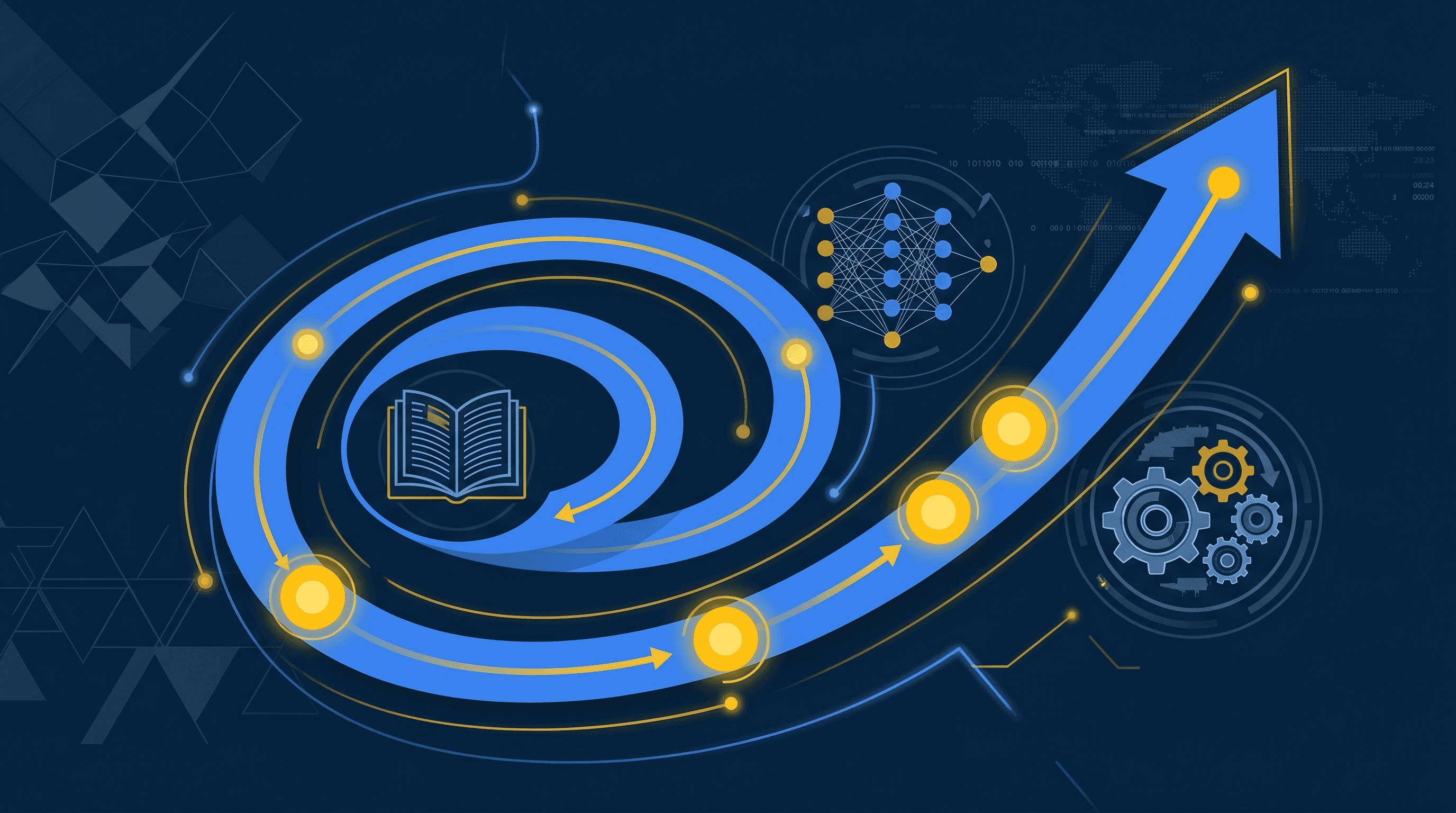
How I Learn Anything Fast: From EOD to AI Strategy (Through the OODA Loop)
I've had to learn everything from parachuting to nuclear physics to AI. Fast, under pressure, and with real consequences.
The method I use isn't talent. It's a system.
And at its core, it's about moving through the OODA Loop faster than the problem in front of you.
Because in any environment, combat, business, or technology, the person who cycles faster wins.
Where It Started
In EOD school, the pace forces you to figure out how to learn quickly, or not at all.
The pipeline runs about 35 weeks, with 2–5 assessments every week. If you fail a test, you retest the next day. Fail again, you roll back. Fail again, you're out.
There's no room for "eventually figuring it out."
You either adapt your learning process, or you fall behind the pace of the system.
The Real Game: Speed of Adaptation
Most people think learning is about understanding more.
It's not.
It's about how quickly you can take in information, make sense of it, act on it, and adjust.
That's the OODA Loop: Observe, Orient, Decide, Act. Then repeat.
The faster you cycle, the more advantage you create.
The System I Use: CODE
Over time, I built a simple system to move through that loop faster. I call it CODE:
Collect → Organize → Distill → Express
C — Collect (Observe): Gather information quickly. Don't try to master it yet. Speed matters more than perfection at this stage.
O — Organize (Orient): Break information into structure. Build rough frameworks that give you about 80% clarity. This is where chaos becomes something you can work with.
D — Distill (Decide): Strip it down to essentials. Close your notes. Take a blank sheet of paper. Work through the problem from memory. This is where you decide what actually matters, and where your gaps are exposed.
E — Express (Act): Teach it. Apply it. Stress test it. If you can't explain it simply, you don't understand it yet. Then you cycle again. Faster each time.
Learning at the Edge
I used this process while working with CBRN threats and training at the national labs.
I had to learn enough nuclear physics to ask meaningful questions to world-class scientists, and then translate their answers into something operators could actually use.
That forced two levels of understanding: depth to engage experts, and simplicity to teach others.
The second one is harder. It forces you to complete the loop, not just stay stuck in observation.
What Learning Actually Feels Like
When I first learned to jump out of an airplane, I wasn't thinking about the view.
I had a sequence: stabilize, check instructor, check altitude, execute turns, repeat.
That was it. No awareness. Just execution.
It wasn't until several jumps later that I could actually see what was happening around me. Because the fundamentals had become automatic.
The Key Insight
Repetition compresses the loop.
At first, every step is slow and deliberate. Over time, observation becomes faster, orientation becomes intuitive, decisions become clearer, and actions become automatic.
That's when you create separation.
Why This Matters in Business and AI
Most teams move too slowly through the loop. They overanalyze, wait for perfect information, delay decisions, and hesitate to act. Meanwhile, the environment keeps moving.
In AI, this is even more pronounced: tools evolve weekly, data is incomplete, and clarity never fully arrives.
The advantage doesn't go to the team that knows the most. It goes to the team that learns and adapts the fastest.
The Takeaway
You don't win by being right. You win by learning faster than the problem changes.
The environment changes. The tools change. But the loop, and how fast you move through it, doesn't.