
AI & Innovation
Why I Automate the Easy Stuff First (And What That Taught Me About Strategy): Most AI automation roadmaps start with the hardest problem. That's the wrong place to start. Here's the sequencing principle I use to build AI capability in organizations, and why it works.

Daniel Dopler
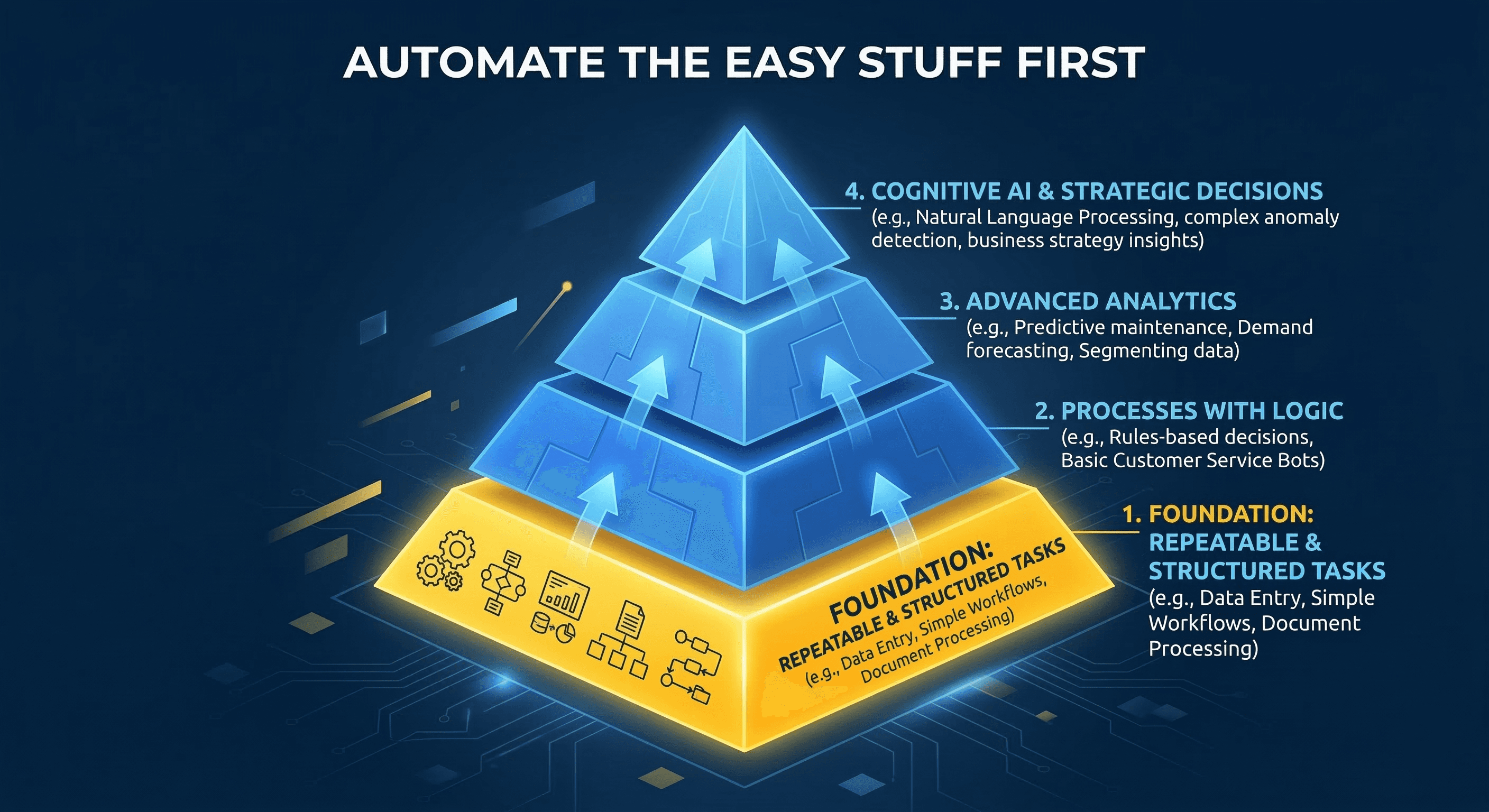
Why I Automate the Easy Stuff First (And What That Taught Me About Strategy)
There's a temptation when building AI capability in an organization to start with the most impressive, complex, or strategic use case. The reasoning is intuitive: big problem, big win, big signal about what AI can do.
It's the wrong place to start. Almost every time.
The Sequencing Problem
When I built JASPER, my personal AI chief of staff, I didn't start with the most complex workflow. I started with the most repetitive one: session continuity. The problem wasn't sophisticated. At the start of every Claude session, I was re-explaining context that I'd explained in the previous session. Forty-five minutes of context-building before any real work could happen.
I automated that first. Within one session, I had a master prompt file that gave Claude full context in under two minutes. The gain was immediate, tangible, and confidence-building.
That win funded the next one.
Why Easy First Works
Starting with easy automation wins does three things that starting with hard problems doesn't.
First, it builds organizational trust in AI faster. Teams that see AI successfully handle a narrow, repetitive task in the first week are far more willing to expand AI use than teams that spent three months on a complex pilot that delivered mixed results.
Second, it creates data. When you automate a simple process, you immediately learn what the AI does well, what it gets wrong, and where human review adds the most value. That knowledge is invaluable when you build toward harder problems.
Third, it builds personal fluency. You learn how to prompt, how to structure AI-assisted workflows, and how to design human-in-the-loop checkpoints, on low-stakes problems, before the stakes are high.
The EOD Parallel
In EOD, we train on controlled scenarios before operating in the field. Not because the controlled scenarios are the real job, but because they build the muscle memory and decision instincts that transfer to the real job.
AI implementation works the same way. The easy automation builds the institutional muscle memory. The hard automation leverages it.
The Sequencing Framework I Use
When I advise organizations on AI adoption, I use a four-quadrant prioritization model: Frequency and Reversibility.
High-frequency, high-reversibility tasks come first. These are the tasks your team does multiple times per day where errors are easy to catch and correct. They have the highest ROI on automation and the lowest risk.
High-frequency, low-reversibility tasks come second, once you've built trust and verification protocols. These are the tasks where errors matter, but the volume justifies the investment.
Low-frequency, high-reversibility tasks come third, if at all. The ROI rarely justifies the investment.
Low-frequency, low-reversibility tasks stay human. Always.
The organizations that get AI wrong are the ones that jump to the fourth quadrant first because it sounds the most impressive. The ones that get it right are the ones that build capability deliberately, starting where the wins are immediate and the risk is low.
Automate the easy stuff first. Strategy will follow.