
Leadership & Strategy
A practical 4-week playbook for diagnosing and stabilizing a dysfunctional operations team, drawn from 20 years of leading high-stakes teams in EOD, deployed environments, and strategic training commands.

Daniel Dopler
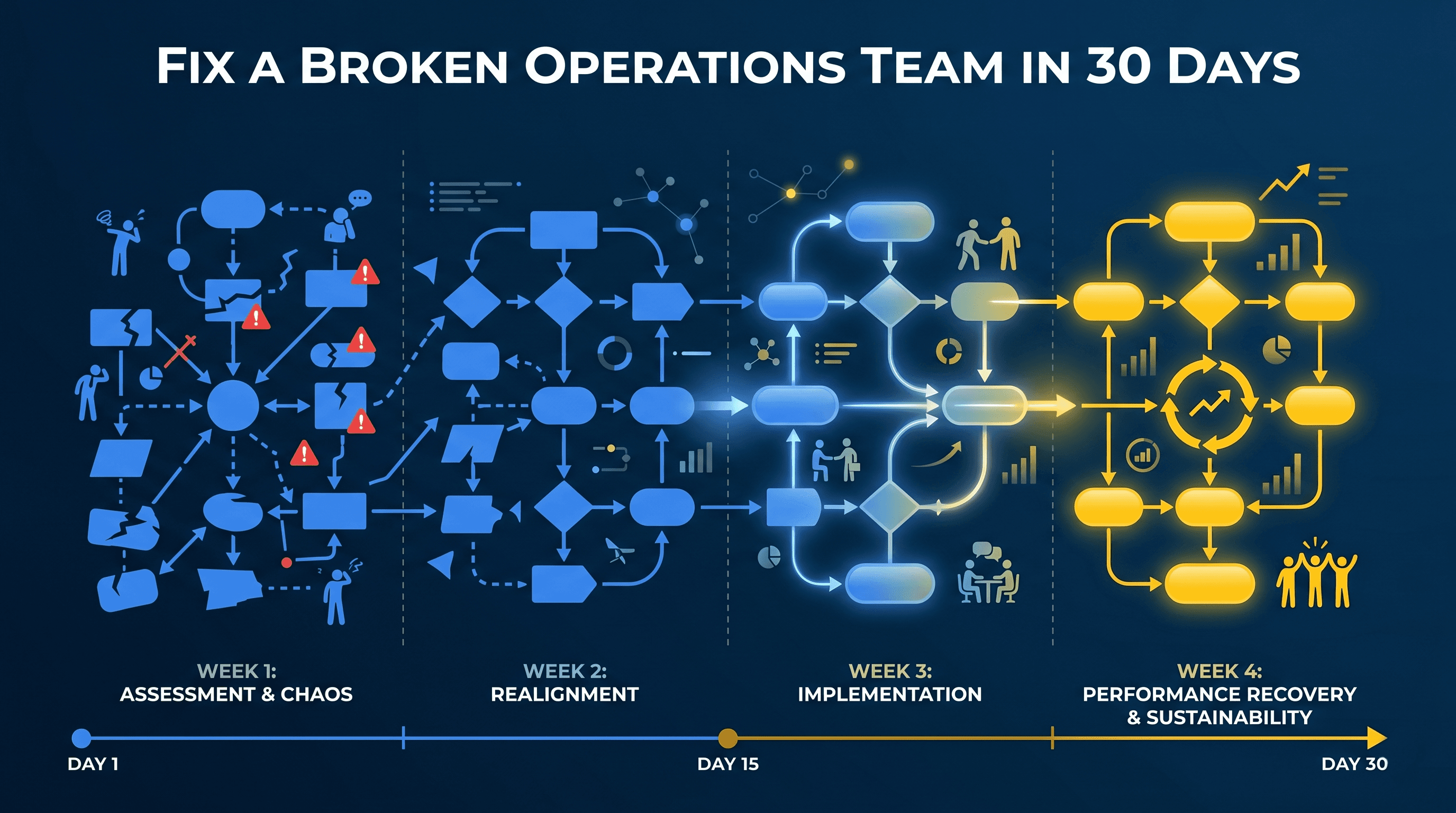
How I Would Fix a Broken Operations Team in 30 Days
When an operations team is broken, the symptoms are usually obvious: missed deadlines, duplicated work, unclear ownership, and a creeping sense that everyone is busy but nothing is actually getting done.
The root cause is almost never the people. It's the system those people are operating in.
Here's the 30-day playbook I'd run if you handed me a broken ops team tomorrow.
Week 1: Diagnose
Before you fix anything, you need to understand what's actually broken. Most new leaders skip this step and start implementing solutions to problems they haven't fully diagnosed. That's how you break things that were working.
What to do:
Sit down with every team member individually. Ask: "What is the most frustrating thing about how we work right now?" Then stop talking.
Map the actual workflow, not the documented one. Follow one work item from request to completion and document every handoff, delay, and rework cycle.
Identify the top three bottlenecks. Where does work pile up? Where does it stall waiting for a decision? Where does it come back for rework?
Look at the metrics you have: throughput, cycle time, error rates. If you don't have metrics, that's diagnosis information too.
What to avoid: Don't announce changes yet. Don't reorganize. Don't install new tools. This week is about observation, not action.
Week 2: Stabilize
You now know where the bleeding is. Stabilize it before you try to optimize anything.
What to do:
Pick the single biggest bottleneck from Week 1 and address only that. Not three things, one.
Clarify ownership for every recurring task that doesn't have a clear owner. Write it down. Communicate it once, clearly.
Establish a simple daily or weekly rhythm, a brief standup, a shared status board, or a weekly team sync. Something that creates visibility without adding meetings.
Identify and eliminate the most common source of rework. Usually, it's ambiguous handoffs or missing context when work is passed between people.
What to avoid: Don't try to fix everything at once. Prioritization under pressure is a leadership skill. Demonstrate it.
Week 3: Optimize
With the immediate bleeding stopped and basic visibility established, you can start improving throughput.
What to do:
Streamline the highest-volume repeating process. Document it in plain language. Get team buy-in. Run it as written for two weeks before changing it again.
Remove one layer of unnecessary approval or review from a process that doesn't require it. Approval chains that exist "just in case" are usually a sign of historical mistrust, not current risk.
Identify the team's best performer in each functional area and have them document how they do their work. Use that as the baseline for everyone else, not some theoretical standard.
Build one simple feedback loop: a way for problems to surface quickly without requiring a formal escalation.
What to avoid: Don't optimize a process you plan to eliminate. Fix the system before you automate it.
Week 4: Scale
You've stabilized, you've optimized the most important workflow, and you have basic visibility and accountability structures in place. Now you prepare for growth.
What to do:
Build a simple capacity model: what workload can this team handle at current headcount and current efficiency? What changes that number?
Identify the next bottleneck. You removed one in Week 2. What's visible now that wasn't before?
Document what you learned. Write down the three biggest changes you made and why. This becomes your operating playbook.
Have a direct conversation with every team member about their growth trajectory. What do they want to learn? What are they underutilized in?
The Key Principle
Most broken operations teams have the same core problem: the system was never designed; it accumulated. Work patterns, approval chains, and communication norms were added one at a time without anyone asking whether the whole thing made sense.
The fix isn't a new tool or a reorganization. It's clarity: clear ownership, clear handoffs, clear standards, clear outcomes.
The Insight
You can diagnose most ops problems in the first week if you're willing to listen more than you talk. You can stabilize most of them in the second week if you're willing to resist the urge to fix everything at once.
The leaders who fail at this do so not because they lack knowledge, but because they move too fast before they understand what they're actually dealing with.
The Takeaway
If you inherited a broken ops team, the most valuable thing you can do in the first 72 hours is resist the urge to change anything. Observe. Ask. Listen. Map the reality of how work moves.
Then fix one thing. Make it stick. And move to the next.