
Career & Transformation
That Is Dumb... Sign Me Up: How I Found EOD Senior Chief Woody Carr looked at me across the table and asked if I was interested in becoming an EOD...
Daniel Dopler
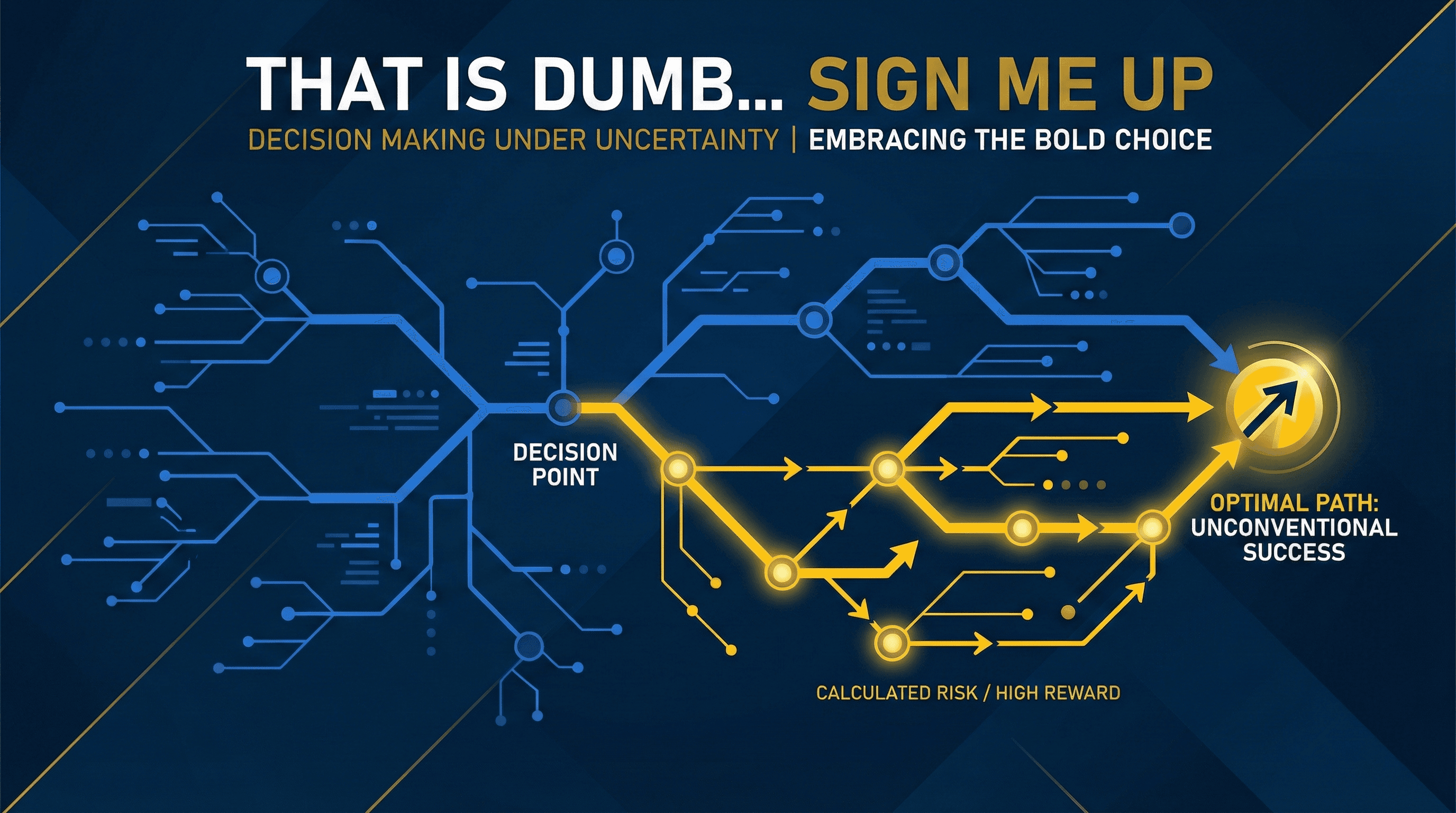
That Is Dumb... Sign Me Up: How I Found EOD
Senior Chief Woody Carr looked at me across the table and asked if I was interested in becoming an EOD technician.
I had just finished telling him about my nerve damage, about Hell Week, about choosing to quit BUDS rather than be medically dropped. I was five months into recovery, helping my friend John through his EOD interview because he didn't want to go alone.
"So you're saying," I said slowly, "that EOD technicians walk up to live bombs and IEDs to disarm them?"
Woody smiled. "Yes, we do."
I paused for exactly one beat.
"That is dumb." Another beat. "Sign me up!"
Woody Carr laughed in my face. It was the exact reaction he was hoping for.
I had no idea that moment would define the next twenty years of my life, or that Woody would later become the Group Master Chief when I was on instructor duty and during my first year at Mobile Unit Eleven. I just knew that after six months of trying to become a Navy SEAL, I had finally found something that felt right.
But to understand why that moment mattered, you have to understand how I ended up in that room in the first place.
The Path That Wasn't
It was the beginning of my third year at Sonoma State University when the planes hit on September 11, 2001. I had been studying to teach history and coach soccer. That morning changed everything.
I pivoted my focus to national security. I took every class I could find on U.S. foreign relations from World War II to present. I added a Political Science minor. I graduated in December 2003 with a BA in History and a singular focus: I wanted to serve in the interest of our country.
I moved to Washington, D.C. in early 2004 to find a job in national security. I had a degree, I had focus, and I had conviction that I could contribute something meaningful.
Six months later, I had nothing. No job offers. No meaningful prospects. Just the slow realization that wanting to serve and having a pathway to serve are very different things.
In mid 2004, I joined the Navy to become an Intelligence Specialist. If I couldn't find my way into national security through civilian channels, I would get there through military service. And I needed a security clearance, which the Navy would provide.
The Job I Didn't Want
In January 2005, during boot camp. One day as I stood in line I saw an Intelligence Specialist and asked him about the job. What he told me was not what the recruiter had sold me on. I would be in a secure room building and presenting briefs that I had little say over the final product. I was no longer interested.
The work wasn't what I had imagined. It wasn't what I had moved to D.C. hoping to find. It was important work, but it wasn't for me.
Coincidentally, the very next class that day was the Special Warfare brief: Navy SEALs, SWCC, EOD, and Diver. The video was designed to pump you up, and it worked. I took the fitness test immediately afterward and barely passed. But barely passing was enough.
I was awarded a BUDS contract. I only knew about Navy SEALs from movies and reputation. I thought they had to be the best, so that's what I wanted to be.
I would still have to complete my Intelligence Specialist "A" and "C" schools, but then I headed to San Diego for my chance to become a Navy SEAL.
Six Months of Preparation
I arrived at BUDS and spent six months in pre-training before the actual course started, because they had canceled that winter class in hopes that more people would pass. It wasn't a waste of time. I watched injuries happen. I asked the affected guys how their injuries started, what the early signs were, and what they wished they had known.
I was studying the system, looking for patterns, trying to understand what separated the people who made it from the people who didn't.
One day during pre-training, we were on the pool deck and the swim coach, a retired SEAL, asked us an off-the-wall question. I don't remember what it was, but I remember it was funny and strange. Everyone else responded immediately without thinking. I hesitated, trying to process the question before responding.
He caught me. He pulled me aside in front of everyone.
"You're too smart to be here," he said. "If you have any chance of making it through, you need to practice this face and this response when instructors call on you."
He showed me what he meant: look down at the ground, leave your mouth slightly open with your tongue sticking out a bit, mumble "I don't know" while shrugging your shoulders.
He made me practice it in front of everyone. "You can't do it to me," he said. "But if you want to complete BUDS, this mindless shrug is the easiest way to defuse instructors screaming in your face."
I practiced. And it worked. The mindless shrug worked so well during BUDS that I started teaching it to others. It became a survival tool, a way to navigate a culture that didn't value the kind of thinking I naturally did.
But it was also a sign. When your intelligence becomes a liability that you have to hide, you might be in the wrong place.
The Injury That Changed Everything
Phase 1
Week 1: I noticed some weakness in my right arm. I couldn't move it equally through a complete range of motion. I adapted and kept going.
Week 2: The weakness became more pronounced. I had to lift my arm out to the side to raise it above my head for pull-ups or when holding boats and logs. I adapted and kept going.
Week 3: Numbness and tingling. Pronounced weakness. I kept going.
Hell Week started Sunday night of Week 4. The first couple of hours, I was fine. Around midnight, we ran to the obstacle course and started log PT.
About halfway through, we were doing lunges while holding a log under our arms across our chests. My right arm just dropped and stopped working. Completely. No warning, no gradual failure. It just stopped.
I quickly grabbed my right arm with my left hand and locked my fingers so my left arm was carrying the right arm and holding it in place. I spent the next day playing cat and mouse with the instructors, using my fingers on my left hand to lock my right arm into position to make it look like it was working.
Tuesday morning was the first medical check. I knew exactly what the first part would be: raise your arms to the side to shoulder height and hold them there. I couldn't do it.
I also knew something else. Because they had canceled the winter class, there were too many people on hold to roll into later classes for medical reasons. From Week 2, we knew that if you got medically injured, there was no chance to roll into another class. You were dropped from the program entirely.
I had a decision to make: was I going to get medically dropped, or was I going to quit on my own terms?
The Decision: Agency Over Outcome
Standing outside the medical check area, I made the choice. I was going to DOR, Drop On Request, the official term for quitting. I didn't want someone else to drop me. I wanted to control that moment.
The outcome would be the same. I would leave BUDS either way. But agency mattered to me. Even in failure, I wanted to own the decision.
It turned out I was the last person to quit during Hell Week that cycle.
Wednesday morning, I went to medical. The doctor examined my arm and told me I was lucky I hadn't tried to push it any further. "You could have severed the nerve," he said. "That would have been very bad."
After testing, he assessed that my right arm would start working again in about five to six months. He was almost exactly right. Five and a half months later, my right arm turned back on. I could lift it. There were strength issues and muscle atrophy, but I had mobility back.
But by then, I had already found something better.
The Friend Who Needed Support
During my recovery in San Diego, I was helping Tony Bruce coach youth soccer. Tony was the Scottish electrician who had coached me in my youth and helped me make the Sonoma State soccer team years earlier. He was coaching at a club in San Diego and allowed me to come out and help coach his teams. The time and space turned out to be helpful in working through what to do next. He had a way of showing up exactly when he was needed.
One day, my friend John told me he didn't want to go to an EOD interview by himself. We had been in the same Intelligence Specialist classes and had trained together for the past year. He was scared to do the interview alone and asked if I would go with him for moral support.
I agreed. I had no intention of switching to EOD. I was just there to support John.
We sat down with Senior Chief Woody Carr. John went first, talking through his background and asking questions about whether EOD would be a good fit for him. At the end of their conversation, Woody turned to me.
"What's your story?"
I told him about BUDS, about the nerve damage, about the DOR decision, about the rehab I was working through.
"Are you interested in EOD?" he asked.
I thought about what I had just learned. EOD technicians walk up to live bombs and improvised explosive devices to disarm them. They render safe some of the most dangerous threats in the world.
"So you're saying you walk up to live bombs and IEDs to disarm them?"
"Yes, we do."
"That is dumb." I paused. "Sign me up!"
Woody Carr laughed in my face.
Why It Was the Right Choice
As Woody explained more about EOD, I started to understand why it was a better fit than SEALs had ever been.
SEALs do incredible work. They conduct direct action missions, special reconnaissance, unconventional warfare. It's high-speed, high-stakes work that requires physical excellence and tactical precision.
But for SEALs, the explosive ordnance work is a side mission. For EOD, it's the entire focus.
And because IEDs were an evolving threat in 2006, there were incredible opportunities to learn. Alarm bypass techniques. Lock picking. Advanced electronics. Circuits and render-safe procedures. The WMD pipeline: chemical, biological, and nuclear weapons. Physics. Engineering. Problem-solving under pressure.
BUDS had been 80% luck, avoiding injury long enough to complete the course. The physical demands were immense, and the culture rewarded not thinking too much.
EOD was different. Dive school was semi-physical, but much of the course focused on the physics and medicine of diving. EOD school itself was almost purely academic, with an 85% attrition rate on the academics alone. People didn't fail because they couldn't do enough push-ups. They failed because they couldn't master the technical material.
After the core EOD course, the Navy had an additional two months of underwater sections that the other services didn't require. Then Jump school. Then the EOD Tactical Training Course in San Diego, the same course I would eventually run at the end of my career.
In June 2008, I arrived at my first duty station: EOD Mobile Unit 5 in Guam.
The Blessing in Disguise
Looking back, the "failure" at BUDS was one of the best things that ever happened to me.
I worked with Navy SEAL teams on two of my six deployments and alongside them on four total. They're exceptional at what they do, and I have enormous respect for their capabilities and their culture.
But I wouldn't have been as happy or as fulfilled as a SEAL as I was as an EOD technician.
The job was more interesting to me. EOD allowed me to learn about diverse technical areas, all in the interest of protecting personnel and property. My time in the military let me work with people from every agency and branch of service. I fell into the right choice by taking the first step and then finding my way as I went.
Woody Carr, the Senior Chief who laughed when I said EOD was dumb, became a Master Chief and eventually the Master Blaster, the longest serving active EOD member in the community. He was our Group Master Chief when I was on instructor duty and during my first year at Mobile Unit Eleven. Every time I saw him, I was reminded that sometimes the best decisions are the ones you make when you have no idea how important they'll turn out to be.
John, the friend who asked me to come to that interview for moral support, is now an EOD Master Chief. We both found exactly what we needed.
The Lessons From Failure
The BUDS experience taught me things I wouldn't have learned any other way.
Lesson 1: Agency matters, even in failure.
I could have let the medical system drop me. The outcome would have been identical. But choosing to DOR rather than being dropped gave me ownership over the decision. It mattered psychologically. It mattered for how I processed what came next. When you control the decision, even a decision to quit, you maintain your sense of self-determination.
Lesson 2: Cultural fit is as important as capability.
I could have completed BUDS if my arm hadn't failed. The mindless shrug was working. I was adapting to the culture. But adaptation isn't the same as fit. When you have to hide your natural strengths to succeed, you're probably in the wrong place.
Lesson 3: Sometimes the best path reveals itself through elimination.
I didn't know EOD existed when I started BUDS. I certainly didn't know it would be a better fit for my temperament and interests. I found it by accident, through a friend who needed moral support. The path to the right answer isn't always obvious from the beginning. Sometimes you have to try the wrong thing first.
Lesson 4: Failure is just redirection.
The swim coach was right. I was too smart for BUDS. Not in an arrogant way, but in the sense that the culture and the job didn't value the kind of thinking I naturally did. EOD did. The technical complexity, the academic rigor, the problem-solving under pressure, that was where I belonged.
What looked like failure in the moment was actually the fastest path to finding the right fit.
The Takeaway: Trust the Process, Even When It Hurts
I spent six months preparing for BUDS. I made it to Hell Week. I chose to quit rather than be medically dropped. By conventional measures, I failed.
But that failure led me to a twenty year career that was more fulfilling, more challenging, and more aligned with who I am than being a SEAL ever would have been.
In my next chapter, I'm looking for organizations that value technical expertise, problem-solving under pressure, and the kind of intelligence that BUDS tried to train out of me. The lessons I learned from choosing to fail, from maintaining agency in difficult moments, and from finding the right cultural fit will serve me well in whatever comes next.
And every time I face a setback or a moment that looks like failure, I'll remember Senior Chief Woody Carr laughing when I said walking up to live bombs was dumb.
Sometimes dumb is exactly where you need to be.
The Principle
The best career decisions often look insane from the outside and inevitable from the inside, and the gap between those two views is exactly where the growth happens.
The Forward Look
I spent twenty years walking toward the things that most people walk away from. Not because I was fearless, I wasn't, but because the calibration question was always the same: is this the kind of hard that builds something, or the kind that just damages something?
EOD was always the first kind. What comes next will be too. I'm carrying two decades of that calibration forward into work that lets me build, not just neutralize.