
Leadership & Strategy
First Follower Leadership: Integrating the First Female EOD Tech with SEAL Teams THE COMPLETE STORY... In October 2018, while...
Daniel Dopler
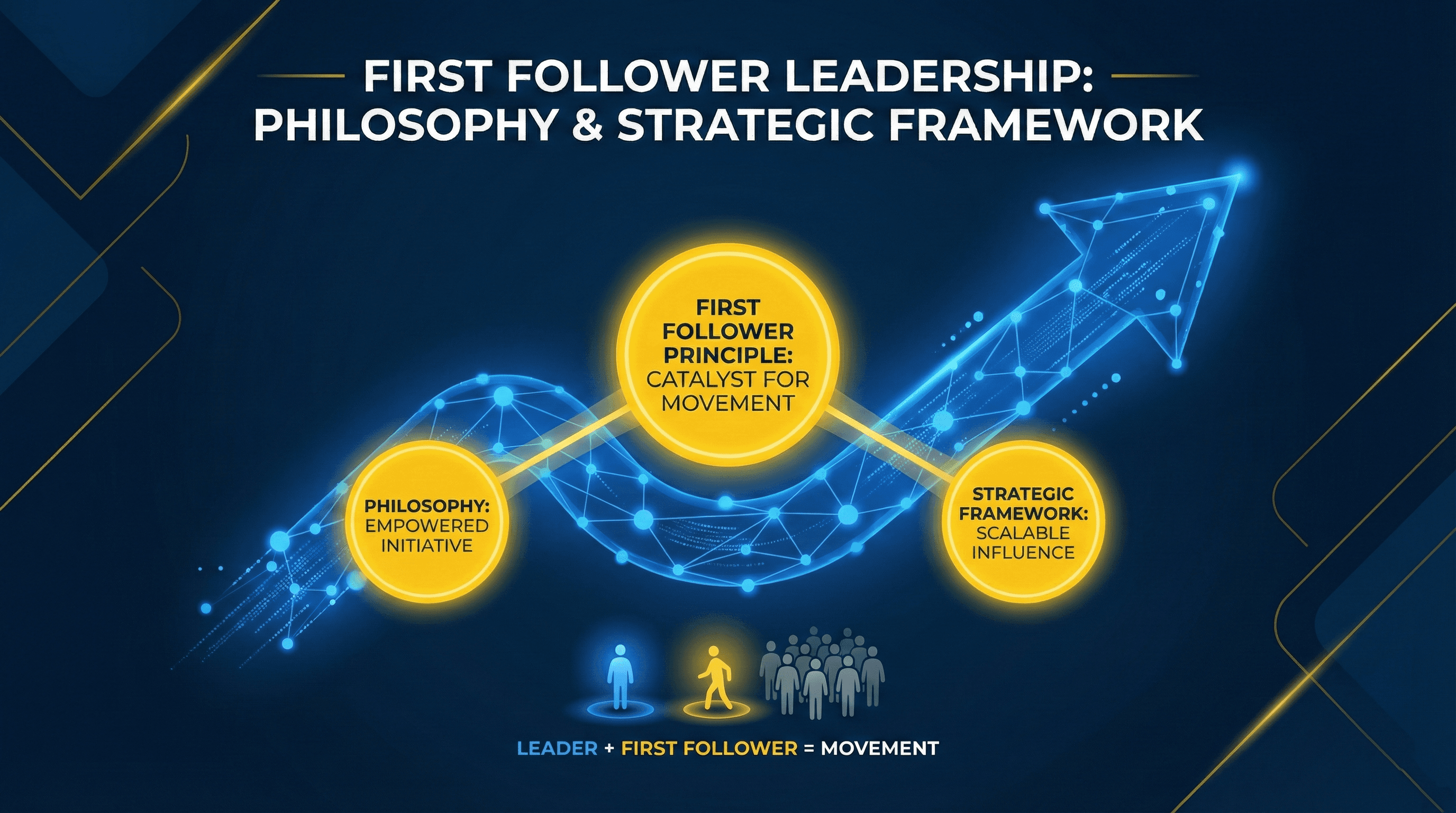
First Follower Leadership: Integrating the First Female EOD Tech with SEAL Teams
The Concept
Most leadership training focuses on the leader. It rarely asks: who moves first after the leader does?
Derek Sivers identified this as First Follower Theory, the idea that a movement requires a first follower more than it requires a bold leader. The first follower is the person who makes the leader look credible instead of crazy. They transform a lone individual into the beginning of a group.
I've seen this play out in boardrooms, on soccer pitches, and in special operations environments. The most critical leadership decision isn't often the one you make, it's the one you make happen.
The Story That Proves It
In October 2018, while still deployed to the UAE with SEAL Team One, I received notification that I would be taking over as Platoon Leading Chief Petty Officer for a new team deploying to Djibouti in October 2019 — only 12 months to prepare instead of the standard 18-month workup cycle.
The team was already formed and training before my return. Then came the detail that defined the deployment: one of my technicians would be the first female enlisted EOD tech to integrate with SEAL Teams. This wasn't an internal integration. This was a historic first in one of the highest-scrutiny environments in naval special operations.
The risk wasn't her ability. It was institutional skepticism and the speed at which failure would be reported compared to success.
The Three-Gate Validation Process
I didn't hope it would work. I built a deliberate process designed to create first followers at every level before the deployment began.
Gate 1: Operator Acceptance: I designed 12 intensive training scenarios that she and I ran with my SEAL teammates over the first two weeks. The goal wasn't just to demonstrate her capability to me. It was to let the operators assess her directly. By the time Gate 1 ended, my SEAL teammates weren't tolerating her integration. They were advocating for it. They had become first followers.
Gate 2: Executive Buy-In: Rather than briefing capabilities myself, I had her lead the capabilities brief to SEAL Team 2's CO and XO. She owned the room. The executive layer moved from oversight mode to support mode. First followers at the top of the org chart.
Gate 3: Field Validation: I leveraged a teammate's family situation to redeploy her five weeks early for field validation in the operational environment. Real conditions. Real missions. Real validation. By the time the team arrived, she had already been operating effectively in the environment for over a month. The integration wasn't a first anymore. It was a fact.
The result: she earned a Navy Achievement Medal and set a precedent that continues today.
How to Apply This
The three-gate model works in any environment where a change faces institutional resistance:
Gate 1 is peer-level validation. Don't ask people to accept something new. Give them a controlled environment to experience it directly and form their own opinion. Peer advocates are more powerful than executive mandates.
Gate 2 is executive cover. Leaders who are seen as supportive early give permission to the middle layer to follow. Get the right people on record as first followers before the stakes are high.
Gate 3 is real-world proof. Simulations only do so much. Find a way to generate field evidence before the full launch. Nothing convinces skeptics faster than results they can point to.
The Counter-Intuitive Point
The temptation when leading a high-stakes first is to make the leader more visible. Brief up the chain. Get senior endorsements. Control the narrative.
The counter-intuitive move is the opposite: step back and let the result speak. The more I positioned her as the subject matter expert rather than positioning myself as the sponsor, the faster the resistance dissolved.
True leadership of a historical first isn't being the person who leads the charge. It's being the person who builds the conditions that make the charge unnecessary.