
Leadership & Strategy
What Underwater Operations Taught Me About Leading Remote Teams, The skills that keep an underwater EOD operator alive in zero-visibility conditions are the same skills that keep distributed teams performing when no one can see each other.

Daniel Dopler
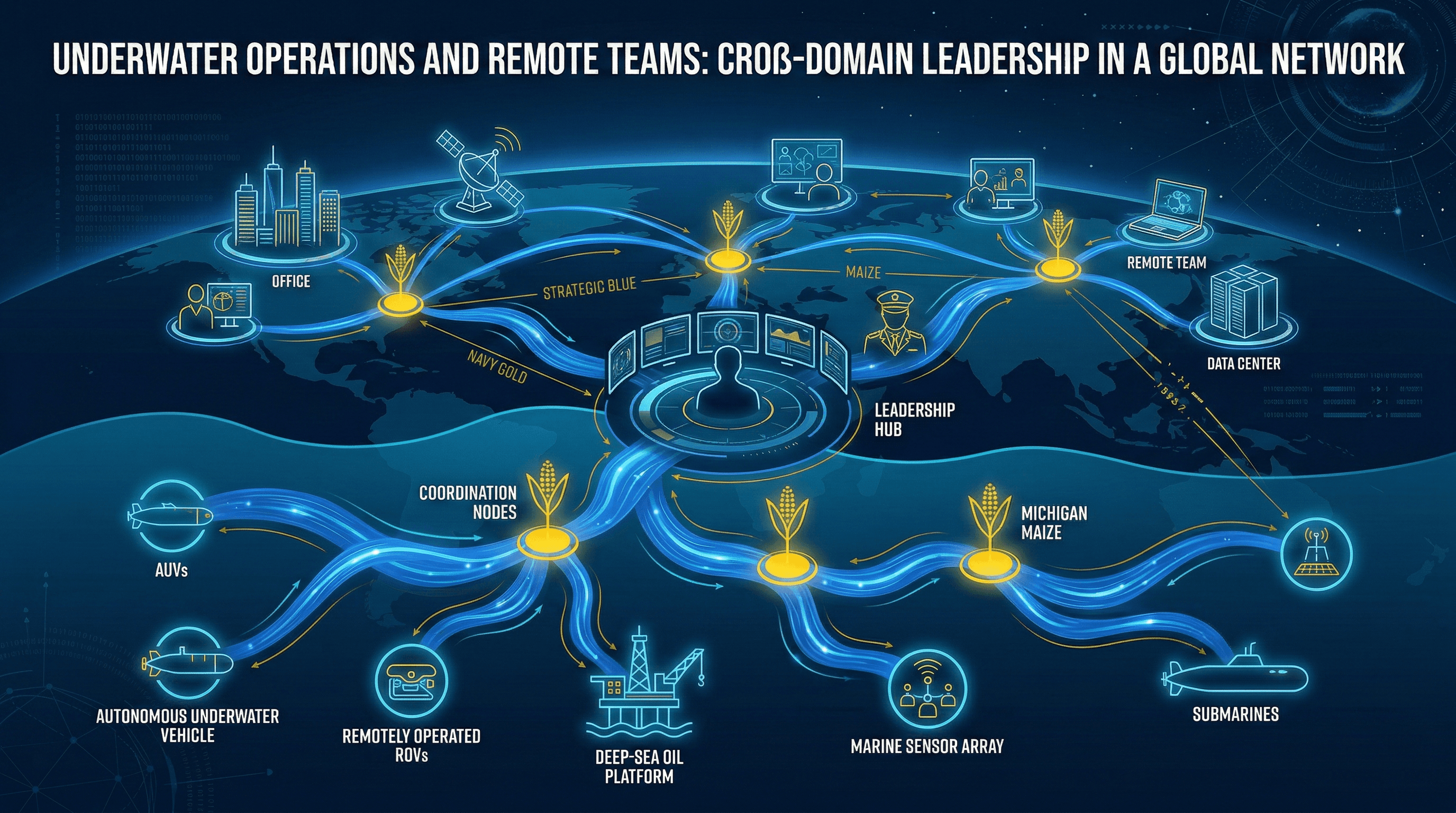
What Underwater Demolition Taught Me About Leading Remote Teams
THE UNEXPECTED CONNECTION
I never expected that learning to work in zero-visibility water with limited communication would become one of the most useful frameworks I'd find for leading distributed teams, but the parallel is almost perfect.
Underwater EOD operations share three constraints with remote team leadership: you can't see the people you're working with, your communication is limited and high-latency, and mistakes made in isolation have collective consequences. Everything that keeps you operationally effective in 40 feet of zero-visibility harbor water is something that keeps distributed teams performing when everyone's on different time zones and Slack doesn't capture what a conversation would.
DOMAIN A: UNDERWATER OPERATIONS
Navy EOD underwater operations training teaches a specific discipline: operating effectively in the absence of direct observation. Underwater, you can't see your swim pair. As a supervisor, you communicate with your divers via line pulls on a safety line. As the dive pair, you communicate via hand signals or touch. Together you operate within a shared mental model of the task, not a shared line of sight.
What keeps the operation safe and effective isn't supervision. It's briefing quality. The pre-dive brief is the most important communication of any dive: exact objectives, contingency signals, abort criteria, and individual assignments. Once you're underwater, the brief is the only authority anyone has. If the brief was vague, the dive is dangerous. If the brief was precise, the dive is almost automatic.
The swim pair doesn't check in with the surface team every three minutes. They execute the brief, respond to what they find, and surface with the result. The quality of the output depends entirely on the quality of the input, the planning, the briefing, and the trust built before the dive began.
THE MOMENT OF TRANSFER
In twenty years of Navy service, I was part of many After-Action Reviews, conducted a few, and was the subject of a few. After every training or operational evolution, there's an AAR. It's normally internal, and the purpose is simple: what worked, what didn't, and how do we improve. Across hundreds of those reviews, roughly 80% of the issues traced back to communication in some form. The rest were usually about actions with consequential impact on personnel or property.
Two examples made this concrete for me.
As a new EOD Tech, I was paired with another team acting as the SCUBA diver for the qualification test of a new SCUBA Diving Supervisor. The evaluation tests the supervisor's ability to manage risk and make correct decisions in critical moments. One scenario specifically tests their ability to maintain control of the dive while hazardous actions are being conducted. The supervisor in this scenario wasn't clear or definitive in his directions, and he failed. He eventually earned the qualification, and on his first real supervised dive, there was a diving casualty. Because he had worked through that scenario in training, he knew exactly what to do when it happened in real life.
The second example came from working alongside Army Special Forces. By the end of every brief, every person was expected to answer questions on every part of the operation, not just their own lane. Being on the same page wasn't a courtesy; it was a tactical requirement. When conditions changed, and they always did, teams were ready to shift immediately to one of two or three contingency options. That's what allows small groups to win asymmetrically.
As a leader, I recognized that the concept and language around briefing needed to be shared, not just used. With each team I worked with, I made it a priority to find how we could implement and practice these skills together. It was vital to build this in training, because I wouldn't always be there when the junior leaders were making the calls.
DOMAIN B: REMOTE TEAMS
The parallel is direct: distributed team failures almost never fail at execution. They fail at briefing.
Ensuring that your junior leaders have the skills to act and respond as you would, in circumstances where you're not available is one of the most valuable investments you can make in a team. In military and high-stakes operational environments, this can mean the difference between life and death, or between a mission accomplished and decisions that carry legal consequences. In organizations, the stakes are different, but the principle is identical.
The team is in multiple locations, operating autonomously, making reasonable decisions in their local context, and the collective output drifts because no one established the shared mental model that makes autonomous execution coherent. The solution isn't more oversight. It's better pre-work.
Specifically: precise objectives (what done looks like, not what we're trying to do), contingency agreements (if X happens, Y acts without asking), individual assignments specific enough to execute without clarification, and explicit abort criteria, when to stop and re-coordinate rather than push through.
The best distributed teams run tight front-end processes and loose back-end processes. Hours of planning, shared context, and contingency design, followed by genuine autonomy during execution. The teams that fail at distributed work invert this: loose planning, tight oversight, constant check-in loops that create the impression of coordination while actually signaling that the brief wasn't strong enough to trust.
SYNTHESIS
The underlying principle in underwater operations and remote team leadership is the same: trust the brief, not the supervisor.
Supervision requires proximity. Briefing requires discipline. The organizations that operate effectively across time zones aren't the ones with better monitoring tools. They're the ones who invest more in the planning and communication that happens before execution begins, and then actually trust the people they briefed.
IMPLICATIONS
Look at your distributed team's failure modes. Are people re-asking questions that should have been answered in planning? Are decisions stalling because someone's waiting for permission that should have been pre-granted? Are outputs misaligned, not because of poor execution, but because the objectives weren't precise enough to produce aligned execution?
If yes, you don't have a remote work problem. You have a briefing problem.
Plan your dive. Dive your plan.