
Career & Transformation
7 Things Navy EOD Taught Me About Managing Up, Two decades of high-stakes operations taught me as much about influencing leadership above me as leading teams below me. Here's the framework.

Daniel Dopler
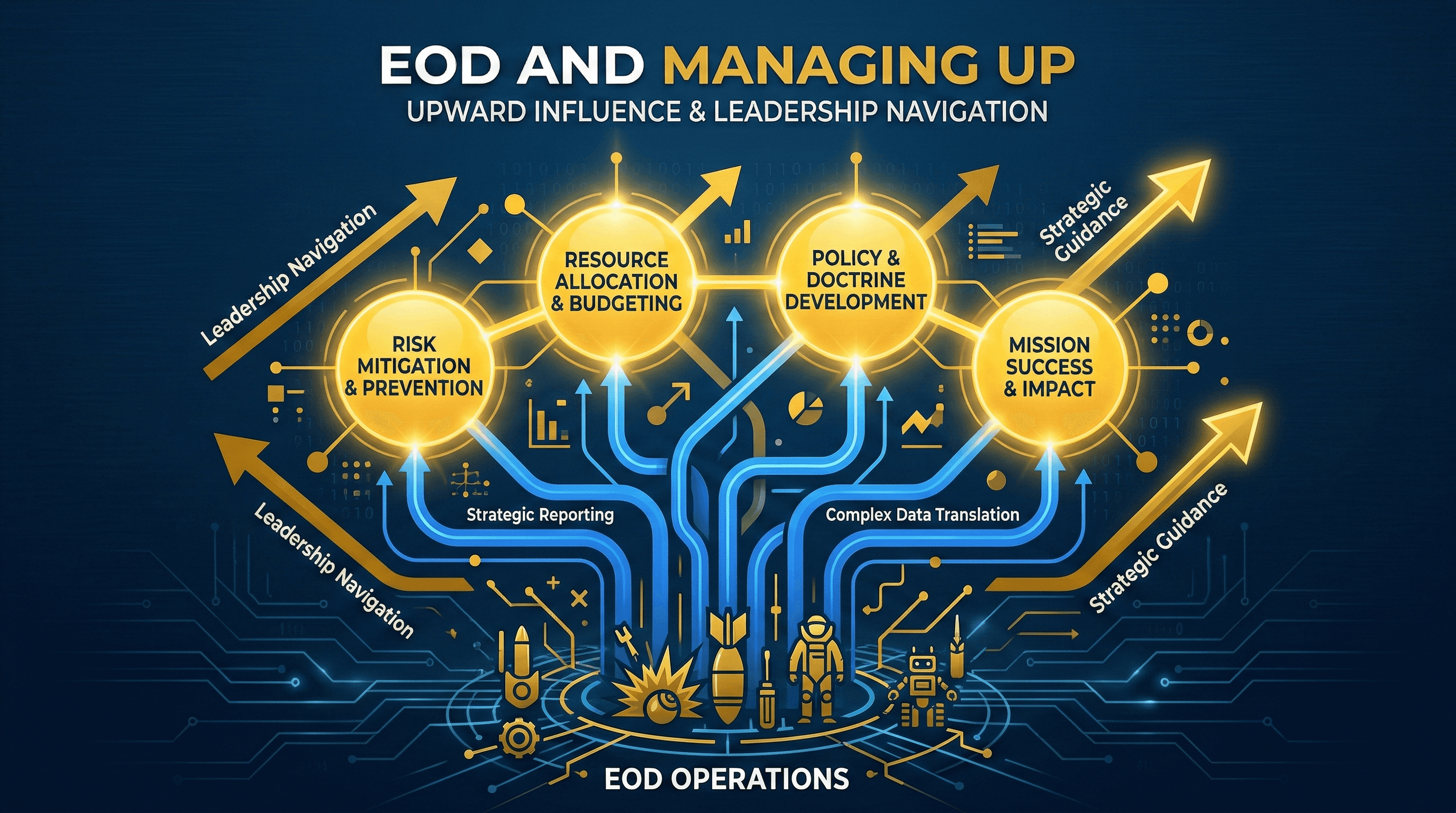
7 Things Navy EOD Taught Me About Managing Up
Two decades as a Navy EOD Operator and Senior Enlisted Leader taught me things about downward leadership I expected to learn. What I didn't expect was how much it taught me about managing the leadership above me, navigating commanders, coordinating with commanders who had no authority over my team, influencing decisions when I had data they didn't, and building the kind of credibility that made my recommendations land.
Here's the framework.
Bring a recommendation, not just a problem.
In EOD, you never call your boss and say "there's a problem." You call and say "I assessed the situation, here's what I think is happening, here's my recommended action, and I need your authorization to proceed." Leadership above you doesn't have the context you have. Giving them a problem and expecting a solution wastes everyone's time. Giving them a recommendation they can approve or redirect keeps the decision where it belongs, with the person who has the most information.
The business parallel: when you bring a problem to your executive team without a recommendation, you're actually asking them to do your job. They'll do it, and they'll form opinions about your judgment in the process.
Quantify the risk, not just the situation.
EOD decision-makers need to understand the probability of harm and the consequences of action or inaction, not just a description of what's in front of us. "There's an IED on the route" is a situation report. "The device has a 70% match to a pattern we've seen at this location three times in 90 days, and the alternate route adds 40 minutes to the convoy timeline" is a risk assessment.
The business parallel: "Our churn is increasing" is a situation report. "We're on pace to lose $2.3M ARR this quarter, with 60% of that concentrated in our mid-market segment" is a risk assessment. The second one produces a conversation. The first produces a question.
Calibrate how much certainty your leader needs before they'll act.
Some commanders needed 90% confidence before they'd authorize a course of action. Others would move on 60%. Neither was wrong; they were different risk tolerances. Learning your commander's threshold wasn't gaming the system. It was speaking their language.
The business parallel: some executives need a full financial model before they'll approve a budget. Others will move on a solid narrative and a directional number. Neither style is irrational. Knowing which one you're working with and presenting accordingly isn't manipulation; it's effective communication.
Separate "what happened" from "what I recommend."
EOD debrief culture trains you to describe events factually before offering interpretation. "The device was buried at 280 meters" is a fact. "This suggests the emplacement team knew our search pattern" is an interpretation. "I recommend extending our search radius to 400 meters going forward" is a recommendation. These are three different things.
Leaders who blur these categories confuse their own analysis with reality. The habit of separating them makes your recommendations more trustworthy because the people above you can follow your reasoning, not just your conclusion.
Make your Boss look good to their Boss.
One of the fastest ways to build upward trust in a military command is to make your immediate superior's reporting to their superior easier. Accurate, concise status updates in the format they need to pass up the chain. Anticipating the questions their superior will ask and having answers ready. Supporting the narrative they're responsible for maintaining.
This isn't politics. It's understanding your role in the information chain and performing it well.
The business parallel: understand what your executive needs to report to the board, and make sure your work generates the data that makes that reporting accurate.
Never surprise your leadership.
The fastest way to destroy upward credibility in EOD operations was to let a situation develop into a crisis without alerting the command element along the way. Early warning, even when the information was incomplete, even when you weren't sure how serious it was, was valued more than confident silence.
"I may have a problem developing, and I'll have more information in 20 minutes" is better than "we have a critical situation" at the moment it's already critical. Leadership above you is managing more than your operation. They need time to adjust. Create the decision space for them.
Push back once, clearly, then execute.
EOD operators are not expected to comply silently when they believe a course of action is unsafe or strategically wrong. You state your concern clearly, once, with your reasoning. Then, if the command decision stands, you execute it with full commitment.
The pattern most damaging to organizational trust isn't disagreement; it's the indirect resistance that follows overruled disagreement: the slow execution, the half-hearted effort, the "I told you so" energy after a setback. You're entitled to your perspective. You're not entitled to sabotage the decision you lost.
The business parallel: say your piece in the meeting. Disagree and commit when the decision is made. The credibility you build by executing fully on decisions you disagreed with is more valuable than being right.
The Thread
Managing up isn't about managing perception. It's about making the people above you more effective at the decisions they have to make, by giving them better information, in a better format, at the right time, with an honest perspective attached.
The leaders I respected most throughout my career were the ones I never had to guess about. They told me what they knew, what they didn't know, what they recommended, and what they needed from me. I've spent twenty years trying to be that for the people above me.
That standard transfers directly.