
AI & Innovation
Most AI initiatives don't fail because of the technology. They fail because of leadership, change management, and system design. An EOD-trained ops leader with an EMBA breaks down why and what successful execution actually looks like.

Daniel Dopler
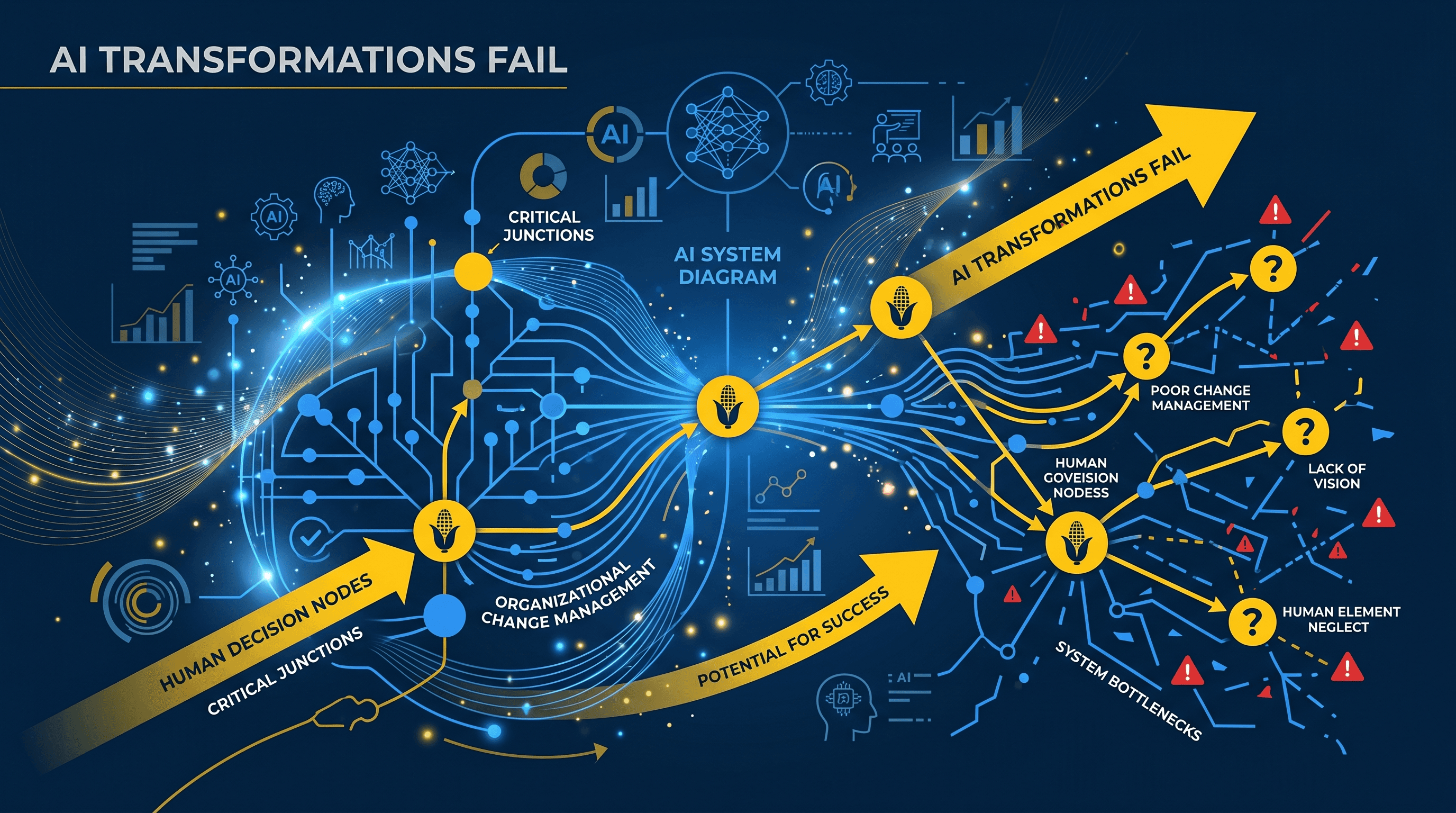
Why Most AI Transformations Will Fail (And How to Actually Execute One)
Most AI transformations will fail. Not because the technology doesn't work. Not because the vendors are wrong. Not because the use cases aren't real.
They'll fail because of the same reasons every major organizational transformation fails: poor change leadership, underestimated operational complexity, and the fundamental human resistance to changing how work gets done.
The technology is the easy part. The people and systems are the hard part. And most organizations are investing their energy in exactly the wrong ratio.
The Three Failure Modes
Failure Mode 1: Automation Without Redesign
The most common mistake. Organizations take an existing process, identify the manual steps, automate them, and declare a transformation.
What they get is a faster version of the same broken process.
Real transformation requires asking: if we weren't constrained by how this has always worked, how would we design this process for a world where AI handles the high-volume, pattern-based work?
That question is uncomfortable because it implies organizational change, not just tool adoption. Most leaders aren't ready for that conversation.
Failure Mode 2: Technology Without Ownership
AI projects die in the space between IT (who owns the tool) and the business unit (who owns the workflow). Neither side has clear accountability for the outcome, so both optimize for their own domain.
IT installs the system. The business unit uses 20% of its capability and spends the rest complaining that it doesn't match their actual workflow.
The fix is simple and politically difficult: one person owns the outcome. Not the tool. The outcome. That person has the authority and accountability to change both the technology and the workflow to close the gap between them.
Without this, you have a tool problem that everyone describes as a people problem and no one fixes.
Failure Mode 3: Capability Without Culture
You can install the best AI system in the world and have it fail because the team's underlying work culture is incompatible with using it effectively.
Teams that distrust data won't adopt AI insights. Teams with high blame cultures won't flag when AI outputs are wrong. Teams without psychological safety won't tell leadership that the system isn't working.
AI amplifies what's already there. If the underlying culture is dysfunctional, AI-powered dysfunction is still dysfunction, just at higher speed.
What Successful Execution Actually Looks Like
I've studied this through the Airbnb ExecMAP project and through 20 years of leading high-performance teams through rapid capability adoption.
The organizations that successfully execute AI transformation do five things consistently.
First, they start with the problem, not the technology. Not "how do we use AI" but "what are the three most expensive problems in our operations right now, and which of them could AI meaningfully address?"
This sounds obvious. Fewer than 20% of organizations actually do it. Most reverse-engineer problems to fit tools they've already decided to buy.
Second, they build a hybrid, don't buy a commodity, don't build what you can buy. The strategic value is in the orchestration logic, the decision rules, and the workflows. That's what you build. The data feeds, the base models, buy those.
Third, they identify and protect the human-in-the-loop. Every AI system has a point where human judgment is required. Successful implementations are explicit about where that point is, what it looks like, and who owns it. Failed implementations discover that point when something goes wrong.
Fourth, they measure operational outcomes, not AI metrics. Not model accuracy. Not inference speed. Revenue per analyst. Time to complete a workflow. Error rate on the output that matters to the customer.
If you can't connect your AI investment to a business metric that someone's compensation is tied to, you don't have a transformation. You have an experiment.
Fifth, they plan for the rollback. Before you go live, know exactly what you'll do if the system doesn't perform. What's the manual fallback? How long can you sustain it? What are the triggers that activate it?
Leaders who can't answer this question don't actually believe their AI system will work. They're just hoping no one asks.
The Insight
AI transformation is change management with a technology component. The organizations that treat it as a technology implementation with a change management component get it backwards.
The leadership challenge is not technical. It's organizational: getting people to change how they work, ensuring accountability for the outcome, and building a culture where the AI is a tool rather than a threat.
That's the same challenge as every major organizational transformation. The difference is the speed at which the gap between early adopters and laggards will grow.
The Takeaway
If you're leading an AI initiative, answer three questions before your next stakeholder meeting: What specific business outcome does this move, and by how much? Who owns that outcome, not the tool, the outcome? What's the rollback plan if it doesn't work?
If you can't answer all three clearly, you don't have a transformation. You have a project. And most projects fail.