
Career & Transformation
A concrete, week-by-week playbook for the first 90 days in a director-level role, drawn from EOD leadership transitions where getting the entry wrong had real operational consequences.

Daniel Dopler
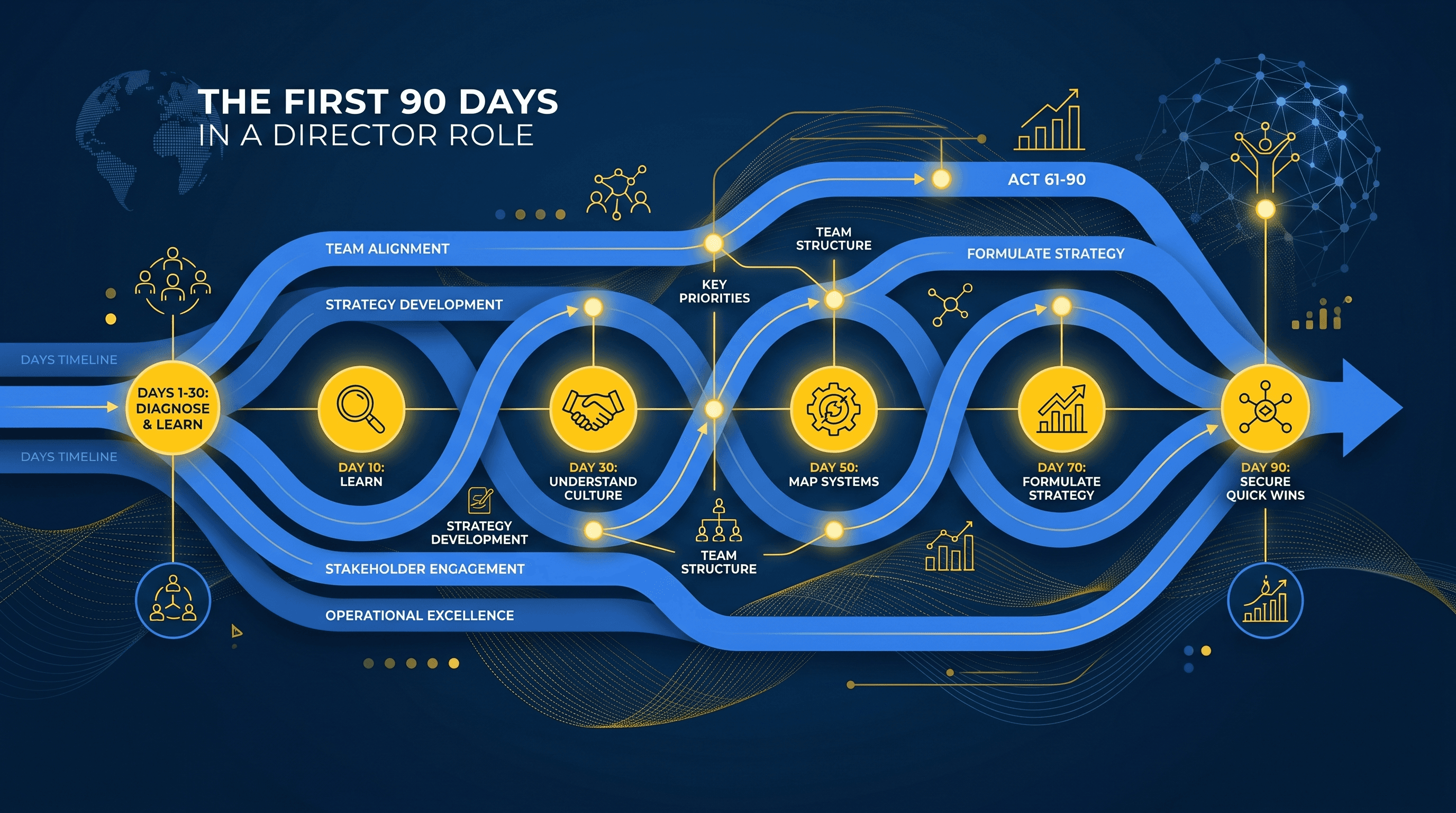
The First 90 Days: How I Would Enter a Director-Level Role
The first 90 days in a new leadership role will either build the foundation for high performance or saddle you with a reputation that takes years to correct.
Most leaders enter new roles doing too much too fast. They announce changes before they understand the system. They project confidence before they've earned credibility. They optimize for looking decisive rather than being effective.
Here's how I would enter a director-level role, drawn from 20 years of leading through rapid organizational transitions in environments where getting the entry wrong had real operational consequences.
The Governing Principle
The goal of the first 90 days is not to transform the organization. It is to understand it deeply enough that when you do act, your actions are informed, targeted, and durable.
Leaders who move too fast in the first 90 days often move backwards in months 4 through 12, reversing decisions made without full context. That's a worse position than if they'd taken the time upfront.
Days 1–30: Listen and Map
The first month is almost entirely diagnostic.
What I'd do:
Meet every person on my team individually within the first two weeks. Ask them: What's working? What's broken? What would you do if you were me? Then actually listen.
Map the real workflow, not the org chart version. Follow a deliverable from request to completion. Identify every handoff, delay, and decision point. Where does work wait? Where does it come back for rework?
Understand the stakeholder landscape. Who are the people my team depends on and who depends on us? What are the expectations and gaps in those relationships?
Identify the organization's definition of success. Not the stated KPIs, those are usually lagging indicators of something. What do senior leaders actually celebrate? What gets people promoted? That tells you what the culture actually values.
What I'd avoid: No reorgs. No new tools. No major process changes. Nothing that signals "I know better than you already" before I've demonstrated that I understand what "better" means in this context.
Days 31–60: Identify and Address the Highest-Value Problems
By day 30, you have a diagnostic. Now you use it.
What I'd do:
Pick the one or two problems where action will have the most visible impact on team performance or stakeholder confidence. Not the most interesting problems. The most important ones.
Communicate transparently: "Here's what I've learned in my first month. Here's what I think the biggest opportunities are. Here's what I'm going to focus on first, and why."
This does something powerful: it shows the team that you listened and that it mattered. It also commits you to a direction, which creates accountability.
Take a small, visible action that solves a real problem the team has been sitting with. Something that demonstrates competence without requiring organizational change. Fix the bottleneck that everyone has complained about for six months and no one has had the authority to address.
What I'd avoid: Trying to solve everything at once. Prioritization is the skill. Demonstrate it.
Days 61–90: Build the Forward Structure
By now you understand the system, you've addressed the most urgent problems, and you've established initial credibility. Now you design for growth.
What I'd do:
Articulate the team's 12-month vision in concrete terms. Not aspirational language, specific outcomes. What will be true in 12 months that isn't true today? How will we know we've succeeded?
Build the operating rhythm. Regular team meetings, one-on-ones, stakeholder syncs, and reporting cadences. These should be designed to surface problems early, not just document progress.
Have a direct conversation with every team member about their career development. What do they want to learn? Where are they underutilized? What would make them more effective?
Begin the stakeholder relationship investment. The people whose cooperation you need in months 6 through 12 need to trust you by month 3. Start building those relationships before you need them.
The Insight
Directors fail most often not because they lack technical competence but because they move from "new" to "decisive" too fast.
The leaders who perform best in the first 90 days, and in the years that follow, are the ones who resist the urge to prove themselves before they've earned the right to be trusted.
They understand that listening is not passivity. It is the most efficient path to informed action.
The Tactical Truth
Every organization has a version of the same problem: smart, capable people operating in systems that were never designed; they accumulated. The leader who takes 30 days to understand that system before acting on it will outperform the one who assumes their previous experience made understanding unnecessary.
The 90-day clock is real. Use it deliberately.
The Takeaway
If you're entering a new director-level role in the next 90 days, write down your first-30-day listening plan before your first day. Who will you meet? What questions will you ask? What will you map?
Then commit to one rule: no major changes until you can articulate the current system's logic in a way that the person who built it would recognize as accurate.
You can't improve what you don't understand. And you can't understand it in your first week.